
High-speed rail network strengthens Northeast China's vitalization
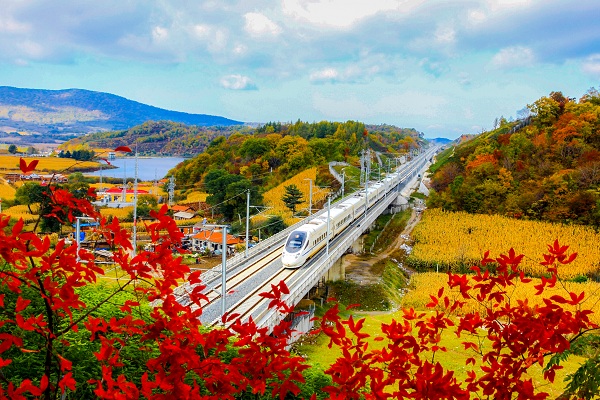
A bullet train runs along the Jilin-Tumen-Hunchun high-speed railway. [Photo provided to gojilin.gov.cn]
The Shenyang branch of China State Railway Group, which operates railways across Liaoning and Jilin provinces and parts of Heilongjiang, Inner Mongolia, and Hebei, has built a high-speed rail network spanning 3,726 kilometers, ranking fifth nationwide.
Over the past decade, its high-speed rail mileage has increased from 1,416 km to 3,726 km, marking a shift from individual lines to an integrated network. The Harbin-Dalian and Beijing-Harbin high-speed railways form major north-south routes, while lines such as the Shenyang-Dandong, Dandong-Dalian, and Xinmin-Tongliao railways have further expanded regional connectivity.
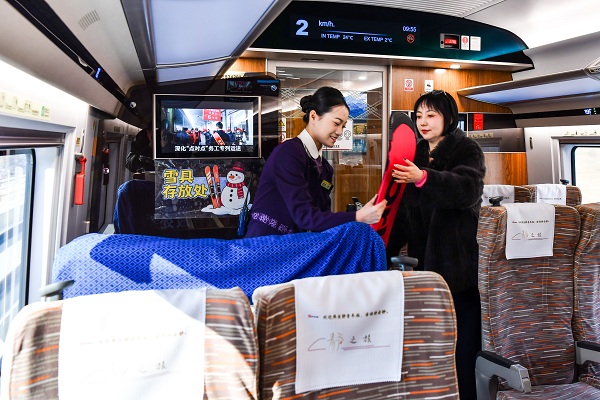
A train attendant helps a passenger stow her ski equipment. [Photo provided to gojilin.gov.cn]
The growing network has shortened travel times and facilitated the movement of talent, capital, and industries across the Liaoning-Jilin urban area, the Harbin-Changchun city cluster, and eastern Inner Mongolia. It has also supported tourism, wellness industries, and the winter economy along railway routes.
Meanwhile, higher passenger capacity has freed up conventional rail capacity for freight, supporting the transportation of energy and grain from Northeast China.
Passenger services have also improved through dynamic daily scheduling, upgraded 12306 functions, flagship Fuxing bullet trains, and differentiated services for key passenger groups. Over the decade, annual passenger trips on multiple-unit trains rose from 94 million to 140 million.