
Changchun hosts 2026 China FAW Technology Conference
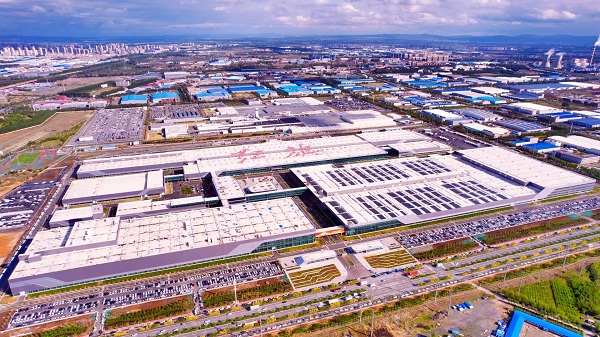
China FAW's Hongqi workshop. [Photo provided to gojilin.gov.cn]
Qiu Xiandong, chairman of China FAW, outlined Hongqi's technology development strategy at the China FAW Technology Conference on Aug 21 in Changchun, Jilin province, establishing FAW's value anchors and defining Hongqi brand aspirations with five genes: Safety & Security, Intelligence, Green, Health, and Taste.
"Looking ahead, Safety & Security will evolve from individual protection into a comprehensive system covering all scenarios and the entire vehicle life-cycle," said Qiu. "Intelligence will advance from single function to proactive vehicle coordination; Green will expand from individual energy-conservation and emissions-reduction to coordinated low-carbon development across the entire value chain; Health will extend from interior environmental health to physical and mental well-being throughout every journey; and Taste will go beyond aesthetic design to emphasize deep integration of oriental luxury and technical experience."
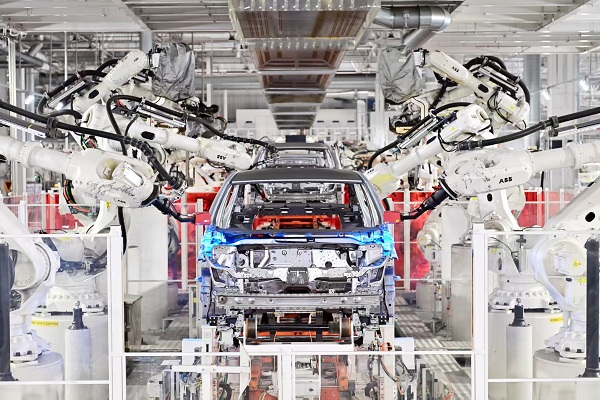
China FAW's automated automobile production line. [Photo provided to gojilin.gov.cn]
He emphasized that "the five brand genes form the underlying logic of our technological innovation" and that the company "will continue to transform Hongqi brand aspirations into mobility lifestyles that users can perceive and experience".
Three major technology platforms lay a solid foundation for realizing Hongqi brand aspirations. The Tiangong Platform focuses on advanced battery-electric propulsion and intelligent control, aiming to achieve breakthroughs in kilovolt super-fast charging and AI-powered chassis systems. Over the medium to long term, the platform will advance in-wheel direct-drive technology and the integrated control of propulsion, braking, steering, and suspension systems.
The Honghu Platform emphasizes efficient powertrains and intelligent energy management, while developing highly integrated emergency range extenders and carbon-neutral engines.
The Jiuzhang Platform concentrates on scenario-based intelligence, exploring the integrated evolution of cockpits with driving-control systems and the large-scale deployment of autonomous driving and AI-powered cockpits.
Facilitated by the five brand genes and the three major platforms, Hongqi is developing 10 strategic tasks, which span the entire value chain from core energy technologies to the mobility ecosystem. Solid-state battery and vehicle-to-grid technologies focus on achieving breakthroughs in energy density and bidirectional charging and discharging, exploring new applications for energy storage and replenishment, with solid-state batteries regarded as the ultimate solution for automotive power.
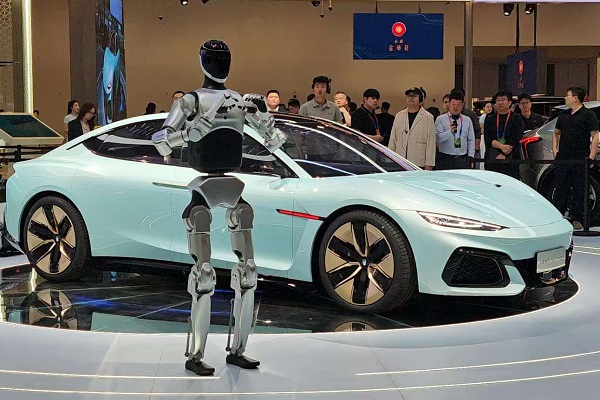
One of China FAW's production models. [Photo provided to gojilin.gov.cn]
China FAW has made achievements in key technologies including low-voltage cell design and thermal-buffering structures for battery modules. It has also established a 25 MWh pilot production line for solid-state battery cells, achieved small-batch production of large-capacity cells, and steadily improved the line's overall yield rate.
China's first innovation center dedicated to all-scenario automotive additive manufacturing was also inaugurated during the conference. Equipped with eight major additive-manufacturing processes and 43 sets of industrial print equipment, the center has an annual production capacity of approximately 19,000 components.
Over the past six years, China FAW has achieved breakthroughs in 1,741 key core technologies, and plans to recruit 10,000 professionals in strategically important fields in the next five years.
"We will integrate into China's national strategic science and technology system by utilizing major national research platforms and premium innovation resources, as well as innovation consortia led by State-owned enterprises," said Qiu, adding that the company will "concentrate innovation resources in priority fields and accelerate the transformation of technological achievements into tangible productivity".