
Jilin advances space science with perovskites
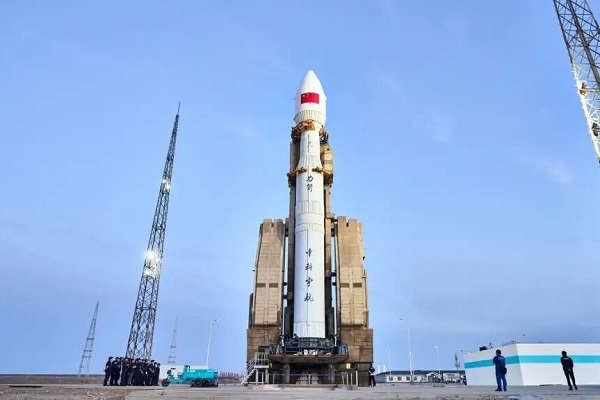
The Lijian-1 carrier rocket prepares for launch. [Photo/Jilin Release]
A space payload developed through a collaboration led by Jilin Hesheng Technology Co, Jilin University, and aerospace research institutes has begun in-orbit operations, marking the world's first orbital verification of a perovskite-based X/γ-ray detector.
The payload was launched aboard the Lijian-1 carrier rocket, which placed five satellites into their planned orbits, and represents the first time that two types of perovskite devices – a radiation detector and a solar cell – are being tested simultaneously in space.
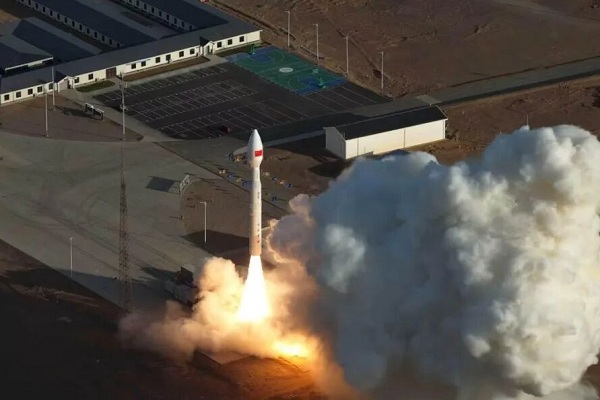
The Lijian-1 carrier rocket blasts off. [Photo/Jilin Release]
Perovskite materials have emerged as one of the most promising materials in optoelectronics, but their performance under the intense radiation and extreme temperature fluctuations of space has remained unproven.
The newly developed payload takes advantage of proprietary perovskite crystal materials to achieve single-photon detection and energy spectrum measurement of X- and gamma-rays under low-voltage operation. Researchers say the technology could provide a cost-effective, highly sensitive solution for applications such as space debris monitoring and high-energy astrophysical observation.
According to project leader Dong Qingfeng, a professor at the College of Chemistry of Jilin University, the research team launched the project in 2021, focusing on three key areas: core perovskite materials, detector devices, and electronic systems. They overcame challenges including radiation-resistant electronics, packaging for extreme temperature cycles, and thermal control for orbital operation.
The payload passed rigorous aerospace qualification tests, including vibration, thermal vacuum, and temperature cycling, before entering orbit.