
Jilin advances new measures for high-level opening-up
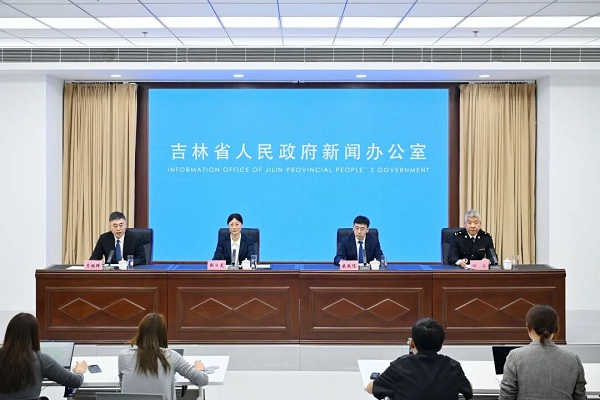
The Jilin provincial conference held on May 21. [Photo/Jilin Release]
Northeast China's Jilin province has outlined a series of measures to advance higher-level opening-up during the 15th Five-Year Plan period (2026-30), focusing on trade growth, cross-border e-commerce, logistics connectivity and port development, according to the information released at a provincial news conference on May 21.
The province plans to implement a foreign trade expansion program featuring automobile exports, cross-border e-commerce, equipment manufacturing and agricultural products, while accelerating the growth of emerging sectors such as green hydrogen, carbon fiber and optoelectronic information.
Efforts will also be made to improve international logistics channels by upgrading railway, highway and aviation ports, expanding China-Europe freight train services and promoting multimodal transport systems.
Jilin aims to enhance customs clearance efficiency through smart port construction, digitalized supervision systems and the wider adoption of "railway express" and TIR transport models.

One of the journalists attending the conference poses a question. [Photo/Jilin Release]
Cross-border e-commerce will remain a key growth driver. The province plans to cultivate industrial belts linked to automobiles, biomedicine, textiles and optoelectronics, while encouraging overseas warehouse construction and cooperation with major international e-commerce platforms.
Jilin will further strengthen opening-up platforms including the Changchun New Area, China-ROK (Changchun) International Cooperation Demonstration Zone and comprehensive bonded zones in Changchun and Hunchun. New "bonded+" business models involving aquatic products, international road transport and cross-border e-commerce will also be expanded.
The province additionally plans to deepen cooperation with Zhejiang province, promote industrial collaboration and innovation partnerships, and improve the business environment through streamlined customs services and digital governance reforms.