
Scholars explore evolving China-Russia relations in Jilin
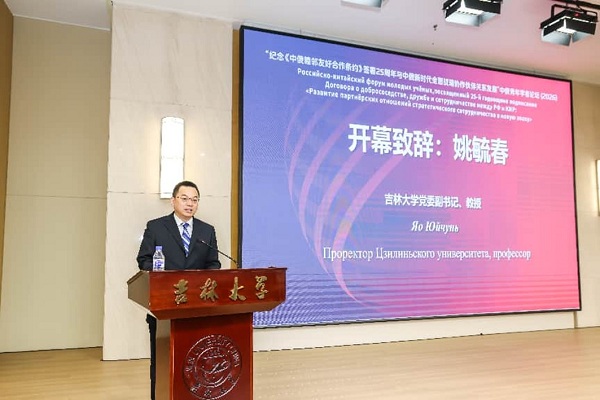
Yao Yuchun, deputy Party secretary of Jilin University, speaks at the forum. [Photo/Jilin University]
The China-Russia Youth Scholars Forum was held at Jilin University on April 23, marking the 25th anniversary of the China-Russia Treaty of Good-Neighborliness and Friendly Cooperation and the continued development of bilateral ties in the new era.
The forum was hosted by the Northeast Asian Research Center of Jilin University, the Institute of China and Contemporary Asia of the Russian Academy of Sciences, and other organizations.
At the opening ceremony, Yao Yuchun, deputy Party secretary of Jilin University, highlighted that 2026 also marks 30 years of the China-Russia comprehensive strategic partnership, noting that bilateral relations have reached their highest level in history.
The forum was positioned as a platform for young scholars to deepen exchanges and contribute fresh perspectives to future cooperation.
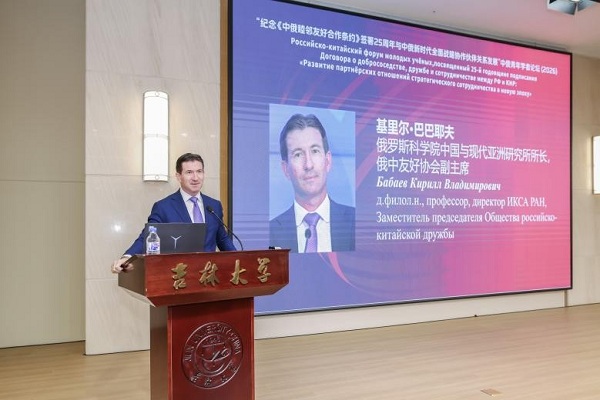
Kirill Babaev speaks at the forum. [Photo/Jilin University]
Kirill Babaev, director of the Institute of China and Contemporary Asia of the Russian Academy of Sciences, reviewed the development of China-Russia relations over the past 25 years. He added that Russia will continue to support young scholars from both countries in conducting joint research on global governance, regional cooperation and technological innovation.
In keynote remarks, speakers from both countries reviewed the steady evolution of bilateral ties and emphasized their close coordination in multilateral frameworks.
Academic presentations offered insights into the structural influence of China-Russia cooperation on the global order, the role of bilateral ties in maintaining international stability, and the achievements and challenges of joint efforts in global governance.
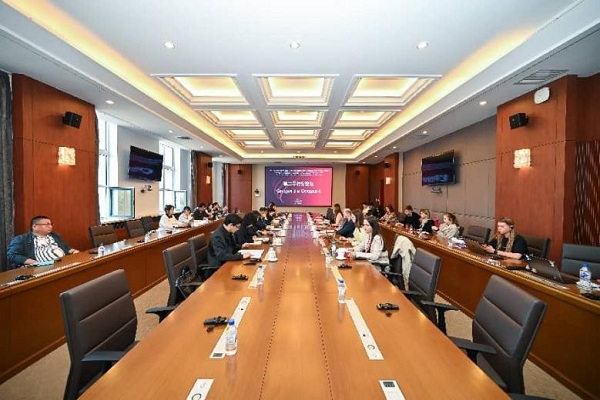
One of the parallel sessions. [Photo/Jilin University]
The forum featured two parallel sessions focusing on pathways of good-neighborly relations, future directions of cooperation, and the evolving characteristics of the comprehensive strategic partnership. More than 30 young scholars from universities in both countries presented their research, contributing to a dynamic exchange of ideas.