
Changchun's restored Fengle Theatre to host orchestral New Year concert
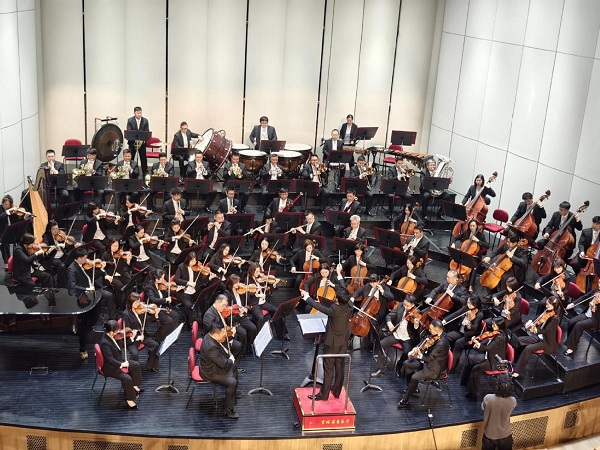
Members of the Jilin Symphony Orchestra rehearse at the Jilin Provincial Music Hall for the upcoming New Year Symphony Concert. [Photo provided to China Daily]
Inside the Jilin Provincial Music Hall, formerly known as the Fengle Theatre, musicians are busy tuning their instruments and practicing scales. The Jilin Symphony Orchestra is rehearsing for its New Year's concert, a moment that signals the reopening of a historic venue now re-entering Changchun's cultural life.
Scheduled for 7 pm on Dec 31, the concert will be the first major performance held at the venue since the completion of its restoration.
The program pairs Chinese classics, including The Yellow River Piano Concerto and Butterfly Lovers, with works by the Strauss family, whose waltzes and polkas are closely associated with Vienna's New Year's Concert tradition. Among them is Johann Strauss I's Chinese Gallop, a piece shaped by 19th-century European imaginings of China.
In a post on its official WeChat account, the orchestra said the program was designed to move between Chinese and Western musical traditions.
For orchestra members, the concert's significance is inseparable from the venue itself. Song Yujia, the orchestra's principal trumpet and a Changchun native, recalls passing the building as a child, when the surrounding streets were a center for film screenings and performances.
"Over time, although the surroundings became more modern and accessible, the cultural presence faded," Song said. "Transforming the old site into a music hall gives the building new life while preserving its historical character."
That sense of connection is echoed by Zhang Tongtong, one of the orchestra's principal players, who described rehearsing in the restored hall as motivating and emotionally resonant. Performing regularly in a historic venue in their home city, he said, is something many local musicians aspire to.
The Fengle Theatre originally opened in 1935, during the period when Changchun, then known as Hsinking, was designated as the capital of the Japanese-controlled puppet state of Manchukuo. Over subsequent decades, the building underwent multiple name changes and functional shifts.
Designated a municipal cultural relics protection unit in 2002 and included in Changchun's first list of historic buildings in 2007, the site later suffered structural damage that prompted its recent restoration. Work began in late 2024, guided by a principle of minimum intervention, according to chief designer Zheng Ning. Historical drawings and photographs were used to reconstruct facade and interior details, while modern infrastructure was added to support contemporary performances.
Acoustic specialist, Yang Zhigang, said the renovated hall now meets international sound standards for venues of its size. Lighting designers worked within strict heritage protection requirements to adapt the stage lighting without changing the building's external appearance.
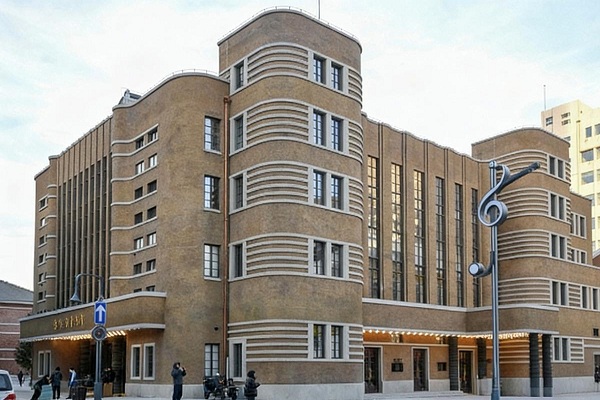
The Jilin Provincial Music Hall, set to host the New Year Concert by the Jilin Symphony Orchestra, continues to evolve as a vibrant urban cultural space in Changchun. [Photo provided to China Daily]
The New Year's concert is part of a broader effort to make orchestral music a regular presence in the city. Changchun resident Yang Min, who often attends concerts with her child, has already purchased tickets for early January. "What draws me here is the history," she said, "and the feeling that this place is alive again."
As rehearsals continue, the Jilin Provincial Music Hall stands at the intersection of memory and renewed use. When the New Year's concert arrives, it will test whether sustained music-making can allow a restored building to once again become part of how a city listens to itself.