
Jilin exhibition reveals proof of Japanese atrocities
The exhibition "Ironclad Evidence – Archives of Japanese Aggression against China". [Video provided to gojilin.gov.cn]
The exhibition "Ironclad Evidence – Archives of Japanese Aggression against China" opened on Dec 12 at the Jilin Provincial Archives, ahead of the 12th National Memorial Day for the Nanjing Massacre Victims on Dec 13.
Designed to remember history, commemorate the fallen, and cherish peace, the exhibition presents a comprehensive narrative of Japan's invasion of China through original archival materials.
Built upon the Jilin Provincial Archives' extensive collection of documents on Japanese aggression, the exhibition follows a clear historical thread. It features seven thematic sections: the Nanjing Massacre, the forced recruitment of "comfort women", violations of international conventions through biological and chemical warfare, the enslavement of laborers in Northeast China, Japan's migration policies, the actions of the Japanese army stationed in Northeast China, and its brutal suppression of the Northeast United Resistance Army.
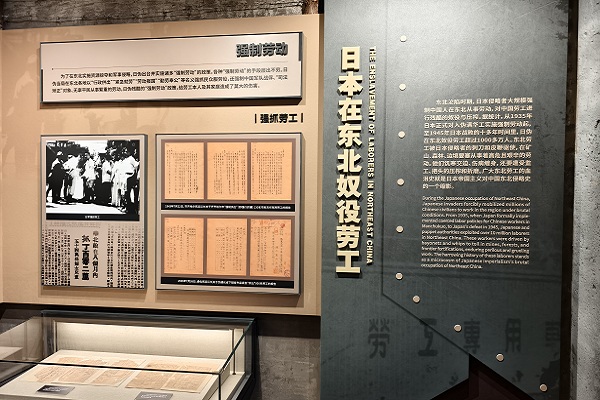
This section illustrates the Japanese army's enslavement of laborers in Northeast China. [Photo provided to gojilin.gov.cn]
A total of 195 archival items and 156 photographs reconstruct the atrocities from multiple dimensions, revealing the violent nature of Japan's invasion and the suffering endured by the Chinese people.
Centered on rare and irreplaceable documents from nearly a century ago, the exhibition offers a multi-perspective and multi-layered view of the war, exposing the crimes of Japanese militarism.
In addition to materials from the provincial archives, the exhibition includes wartime postal mail, reports on the Nanjing Massacre, and other records provided by Changchun Normal University, thereby broadening the historical scope and moving beyond single-narrative interpretations.
The Nanjing Massacre section, a main part of the exhibition, is structured around the principles of cross-verified evidence and three-dimensional historical reconstruction. Drawing on six items from the Jilin Provincial Archives that are inscribed on the UNESCO Memory of the World Register, this section presents the atrocity through three units: "The March toward Nanjing", "The Fall of Nanjing in Japanese Military Documents", and "The Civilians Under Massacre".
The contrast between devastated homes, desperate civilians, and the brutality of invading troops offers irrefutable proof of the massacre's reality and scale.
Wang Meiling, a PhD candidate in Chinese History at Changchun Normal University, emphasized the decades-long work of Professor Li Suzhen and her team, who have collected Japanese-held war records for thirty years, yielding 1,800 hours of oral testimonies, thousands of battlefield diaries, military mail, and visual materials.
The university has also hosted academic events marking the 80th anniversary of the victory of the Chinese People's War of Resistance Against Japanese Aggression and the World Anti-Fascist War, and established a dedicated memorial hall on the history of Japan's invasion.